Saturday, November 6, 2010


"Freud remained deeply suspicious of philosophers and their speculations. Fond of repeating his conviction that psychoanalysis has little to learn from philosophy, he more than once compared philosophical systems to the delusions of paranoiacs and suggested that the primary impact of psychoanalysis on philosophy might consist in affording new insight into the personal quirks that motivate philosophical theory-building. The most common error of philosophers, he thought, is their restriction of the sphere of the mental life to conscious activity. But equally questionable is their tendency to project for themselves a seamless account of reality, their penchant for 'clinging to the illusion of being able to present a picture of the universe that is without gaps and is coherent' (SE, 22:160). Among Freud's favorite quotations was Heine's derisive caricature of the philosopher: 'With his nightcaps and the tatters of his dressing gown he patches up the gaps in the structure of the universe' (SE, 22:161)."

-Richard Boothby, Freud as Philosopher p. 283

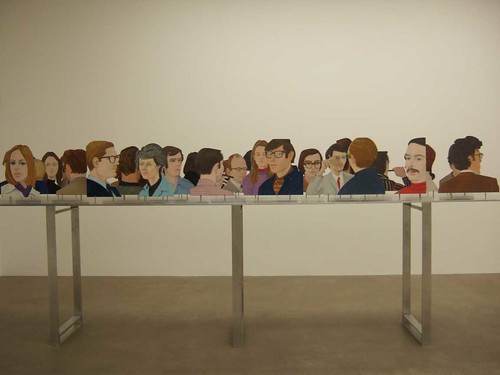
(Illustration: Magritte, Philosopher's Lamp)

Wednesday, October 27, 2010


David Brooks in The New York Times:

"I’m totally confused about what the political impact of Stewart-stock and Colbert-palooza will be. On the one hand, watching their shows I get the impression they are generally mainstream liberals. On the other hand I do think their shows are unintentionally conservative. Just as the show '60 Minutes' sends the collective message that political institutions are corrupt, so the Comedy Central shows send the message that politicians are buffoons. Both messages undermine faith in political action and public sector endeavor and so cut right against the intentions of their founders."

The only time I've admired either of these guys was during Colbert's speech at the White House correspondent's dinner... but even then, it's hard to accept that some political project exists behind the irony.

Saturday, October 23, 2010

This guy is wrong. Drunk driving laws create a climate of fear that prevents people from driving drunk. I'd rather live in a world with clearly defined limits (like .08) than in constant fear that my driving is too "erratic" in the eyes of a random police officer.

I especially liked this line: "Bill Lewis, head of the Texas chapter of Mothers Against Drunk Driving, agreed."

Bill Lewis must appreciate the rhetorical value of "Mothers."

Yesterday I read a couple of chapters from Martha Nussbaum's Poetic Justice. I’m not sure I agree with Nussbaum’s claim that literature’s ability, through “identification and emotional reaction,” to “cut through [one's] self-protective strategems” ought to be “palatable” or “pleasurable” (6).

For me, a good book or film is a harrowing, painful experience. Indeed, if a “novel constructs a paradigm of a style of ethical reasoning” that generates “potentially universalizable concrete prescriptions,” it cannot function as mere entertainment; it needs to break down its reader and inflict the pain of a new awareness, like an ethical boot camp (8).

A poetic kind of justice must punish readers if it is to have any motivational efficacy; otherwise, isn’t Nussbaum talking about something as brief, flighty, and forgettable as so many bad poems?

This argument reminds me of film historian Scott MacDonald's discussion of a political kind of spectatorship. MacDonald talks about a way of watching challenging, often boring, critical/avant-garde films (Adventures in Perception, 2009). The films he mentions are only political if the audience informally challenges each other to experience something new; sticking it out in the theater, talking about it afterward, but most importantly of all, paying attention. Few watch these kinds of films, especially because the escapism of Netflix is so much easier. Poetic justice in the cinema, therefore, remains a distant hope (especially if you ask Ray Carney about it).

Tuesday, September 28, 2010


“The invocation of ‘evil’ in the language of the nineteenth century Temperance Movement and the twenty-first century war on drugs is more than a trivial coincidence. To secularists, the word ‘evil’ may be synonymous with ‘very bad.’ But to the religiously inclined, evil can represent the unified and active force of Satan in opposition to all that is good. Defining a problem as an unqualified evil makes it that much easier to draw normative boundaries and crack down on those who fall on the wrong side of the divide—the evildoers. As a moral crusade, prohibition is a fight against evil, a shining path to the pearly gates. The problem with this position, both practically and theologically, is that drugs are chemicals without a moral agenda. Even drugs that are undoubtedly bad are not evil.” Peter Moskos, Cop in the Hood p.160

Moskos’ experiences in the Baltimore city police department make for entertaining reading, but his academic approach to the drug war misses the forest for the trees. While drugs are indeed simple chemicals with no intrinsic evil, drug addiction is a spiritual crisis that engenders evil actions. Addiction (from the Latin “religious devotion”) is evil because it opposes life. The drug addict abandons society, rejects his or her obligation to others, and escapes his or her own feelings. If we want to live in a functional society, we can never decriminalize all drugs.

Alcoholism is evil. Alcohol is not. The reason that alcohol is legal is that its addiction is harder to slip into: hangovers, social pressure, and alcohol’s own potency each ensure that an addict must work hard to become enslaved. It takes a lot of despair to drive drunk to work at eight in the morning. Not so with opiates, for instance. That high is easy, and there is no hangover. Physical dependency begins without the desperation that drives a drunk. Opiates satisfy consumer society’s injunction to enjoy better than any product because they are chemicals: they directly increase enjoyment in a reliable way, and often become available in easy installments of $10.00.

So what should we do? Instead of a war on drugs, perhaps we should wage a war on addiction. The “normative boundaries” of a war against evil have their motivational purpose: as Donald Barthelme once wrote, “Fear is the great mover, in the end.” We should fear addiction and condemn drugs. But Moskos is right to insist that a carceral state isn’t the proper vehicle for the war.

Related to drugs in Baltimore, an article in the NYRB: http://www.nybooks.com/articles/archives/2010/oct/14/life-wire/ that discusses the TV show the Wire would have benefited from a more careful viewing.

For example:


[Chris and Snoop] open Season Four using a nail gun—a nod, perhaps, to Cormac McCarthy’s cattle bolt—to kill young black men (number one males, in police terminology).
-they use a silenced gun, this is not a nod toward McCarthy.

For a feminist heroine the show has only the quite imperfect Detective Kima Greggs, and only because in her strength, humor, passion for work, and apparently secure hold on her biracial identity and lesbianism, she is slightly better than almost anyone else.

-so Rhonda and Marla Daniels don't count?

Tuesday, September 21, 2010


There was once a generation of Americans who fought in a world war. They were called the greatest generation because they were sexist, racist, and weren’t afraid to say that they believed in community norms. These included sneaking a kiss and ‘smear the queer.’ You could find out more if you asked your older brother.

Then their children, the baby-boomers, began to grow up and the older generation became alcoholics.


For the greatest generation, your friends were secretly more important than yourself. This has its pluses and minuses. But their kids never fought in a war together, they just watched it on TV.


The baby-boomers were so resentful for that, they bought whatever they could to express it. Doyle, Dane, and Bernbach.


Then the greatest generation surrendered. The baby-boomers just wanted to enjoy life, was that so wrong?


The thing about it was that no one knows how to enjoy anything unless someone explains it to you. Even sex.


Community norms became the province of big companies, who created far more stringent and exclusionary rules than anything possible just after the world war. I call these the secret rules, because they are properly ideological (as in, ‘they do not know it, but they are doing it’).


But the problem was that communities based on buying things only talked to each other about buying things, layout/design, and enjoyment. They didn’t know how to deal with something like domestic abuse unless it could be put into syndication. They liked buying things because it didn’t hurt. You always feel better an hour after watching Schindler's List.


The rules of the greatest generation hurt a lot.


As the century went on, social mores became further and further defined by the new secret rules, until everyone was impossibly free. You can’t deny it. One secret rule is this: you will always feel stupid talking about the things most important to you.


This site is annoying. In the FAQ, it states: "We live in a culture where advertisers directly influence and in some cases control and create the culture at large. Honesty of the writing is affected when corporate interests are paying the bills." Note that the owl has closed its eyes.

Blogging is not the creation of culture. There is no knowledge in shorthand observations and accumulated links. Instead blogs feed consumption by always pointing outward, toward more images, books, feelings, and ideas. Maybe some readers dig deep through these signals and come to appreciate new forms of art - but then, it's not the blog that's doing the work. Indeed, blogs are essentially one-person advertising agencies, who prove the value and intelligence of an author by recommending the right things.

Anyway, most corporations are far too clever to advertise on low-rent blogs. It seems that pyramid schemes and discount clothing retailers buy more Google Ads than anything on the NYSE.

If you don't want your blog to enable consumption, delete it. And if your blog is meant to display family photos or other private content, no one is there to look at the ads in the first place.

Friday, August 20, 2010


XXII. FRUIT BOWL

His mother was sitting at the kitchen table when Geryon opened the screen door.


He had taken the local bus from Hades. Seven-hour trip. He wept most of the way.

Wanted to go straight to his room

and shut the door but when he saw her he sat down. Hands in his jacket.

She smoked in silence a moment

then rested her chin against her hand. Eyes on his chest. Nice T-shirt, she said.

It was a red singlet with white letters

that read TENDER

LOIN. Herakles gave it--and here Geryon had meant

to slide past the name coolly

but such a cloud of agony poured up his soul he couldn't remember

what he was saying.

He sat forward. She exhaled. She was watching his hands so he unclenched them

from the edge

of the table and began spinning the fruit bowl slowly. He spun it clockwise.

Counterclockwise. Clockwise.

Why is this fruit bowl always here? He stopped and held it by the rims.

It's always here and it never

has any fruit in it. Been here all my life and never had fruit in it yet. Doesn't

that bother you? How do we even

know it's a fruit bowl?
She regarded him through smoke. How do you think it feels

growing up in a house full

of empty fruit bowls?
His voice was high. His eyes met hers and they began

to laugh. They laughed

until tears ran down. Then they sat quiet. Drifted back

to opposite walls.

They spoke of a number of things, laundry, Geryon's brother doing drugs,

the light in the bathroom.

At one point she took out a cigarette, looked at it, put it back. Geryon laid

his head on his arms on the table.

He was very sleepy. finally they rose and went their ways. The fruit bowl

stayed there. Yes empty.

-Anne Carson, from Autobiography of Red